
Currently Empty: $0.00
Research only

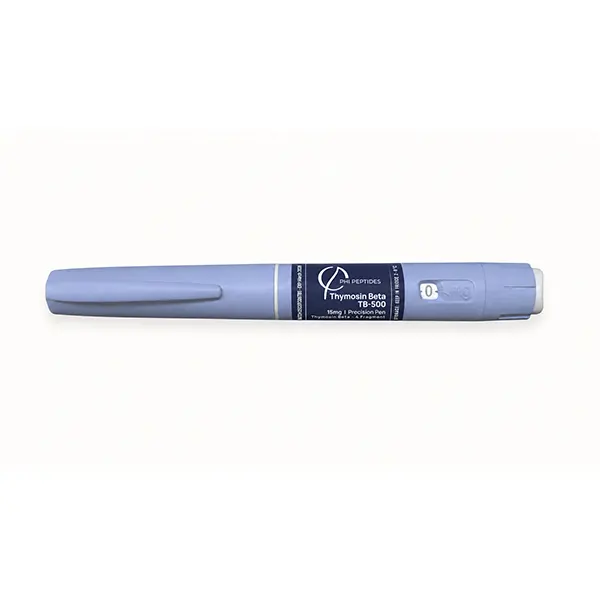
A synthetic fragment of thymosin beta-4, an actin-binding protein central to cell migration and tissue repair.
| Standard Delivery (Signed for) | Delivered within 3-5 working days |
| Express Delivery (Standard Parcels) | Delivered within 1-2 working days |
| Extra-Large Parcels (Signed for) | Delivered within 3-5 working days |
| Furniture | Delivery usually takes place within 2 weeks. |
Allow sealed vials to equilibrate to ambient laboratory temperature before opening. This helps minimise the risk of condensation forming within the vial. Keep unopened vials stored at 2-8 C, protected from direct light and moisture. All handling, storage after opening, and laboratory procedures should be carried out according to the receiving laboratory’s established protocols and applicable requirements.
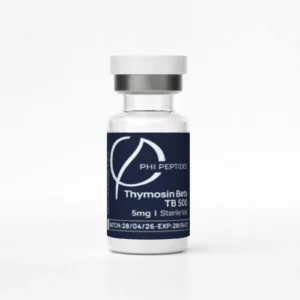
Thymosin beta-4 is a naturally occurring 43-amino-acid protein and the principal actin-sequestering molecule in mammalian cells, present in nearly every cell type and released at sites of injury. TB-500 refers to a synthetic fragment corresponding to the active actin-binding region. The parent molecule has a credible research history: full-length thymosin beta-4 entered controlled clinical trials for dermal wound healing and corneal injury, with acceptable safety and some encouraging findings, though development did not reach approval. The important distinction, which is often blurred in this market, is that the clinical trial data relate to full-length thymosin beta-4, not to the TB-500 fragment. PHI supplies TB-500 for clinician-directed use, and practitioners should draw that distinction accurately when discussing evidence.
Active Compound: TB-500 (Thymosin Beta-4 fragment)
Permitted Claim GuidelinesA fragment of thymosin beta-4, an endogenous actin-binding protein studied in tissue repair. Used under practitioner supervision. Human evidence relates to the full-length parent molecule.
Binds and sequesters G-actin, regulating actin polymerisation and thereby cell motility. This underpins accelerated migration of endothelial cells, keratinocytes and stem cells into injured tissue. Additional reported effects include promotion of angiogenesis, downregulation of inflammatory cytokines, and inhibition of myofibroblast differentiation, which is proposed to reduce fibrotic scarring.
Evidence Grade: C - Human trials of the parent molecule; the supplied fragment is preclinical only
Clinical Evidence BaseFull-length thymosin beta-4 completed Phase I and Phase II trials in dermal and corneal wound healing with acceptable safety; efficacy findings were mixed and development did not proceed to approval. Preclinical data are extensive across cardiac, dermal and neural injury models. The TB-500 fragment specifically has not been evaluated in controlled human trials.
Literature & ReferencesGoldstein AL, Hannappel E, Kleinman HK. Trends Mol Med, 2005 - thymosin beta-4, actin-sequestering protein moonlights. | Malinda KM et al. J Invest Dermatol, 1999 - thymosin beta-4 accelerates wound healing. | Crockford D et al. Ann N Y Acad Sci, 2010 - thymosin beta-4, clinical development and safety. | Bock-Marquette I et al. Nature, 2004 - thymosin beta-4 activates cardiac repair.
The parent molecule was well tolerated in clinical trials. Human safety data for the fragment are absent. As with any angiogenic and cell-migration-promoting agent, the theoretical concern is behaviour in the presence of occult malignancy, and this is unresolved. Not for use in pregnancy or breastfeeding. Injection-site reactions and transient fatigue or lightheadedness have been reported anecdotally.
ContraindicationsActive or suspected malignancy; pregnancy and breastfeeding; known hypersensitivity.
Storage & HandlingStore lyophilised vial at 2-8 C, protected from light.
Not authorised as a medicine in the UK, EU or US. Prohibited in sport under the WADA Prohibited List (S0/S2). Supplied only through appropriate professional, prescription-led channels.