
Currently Empty: $0.00
Research only

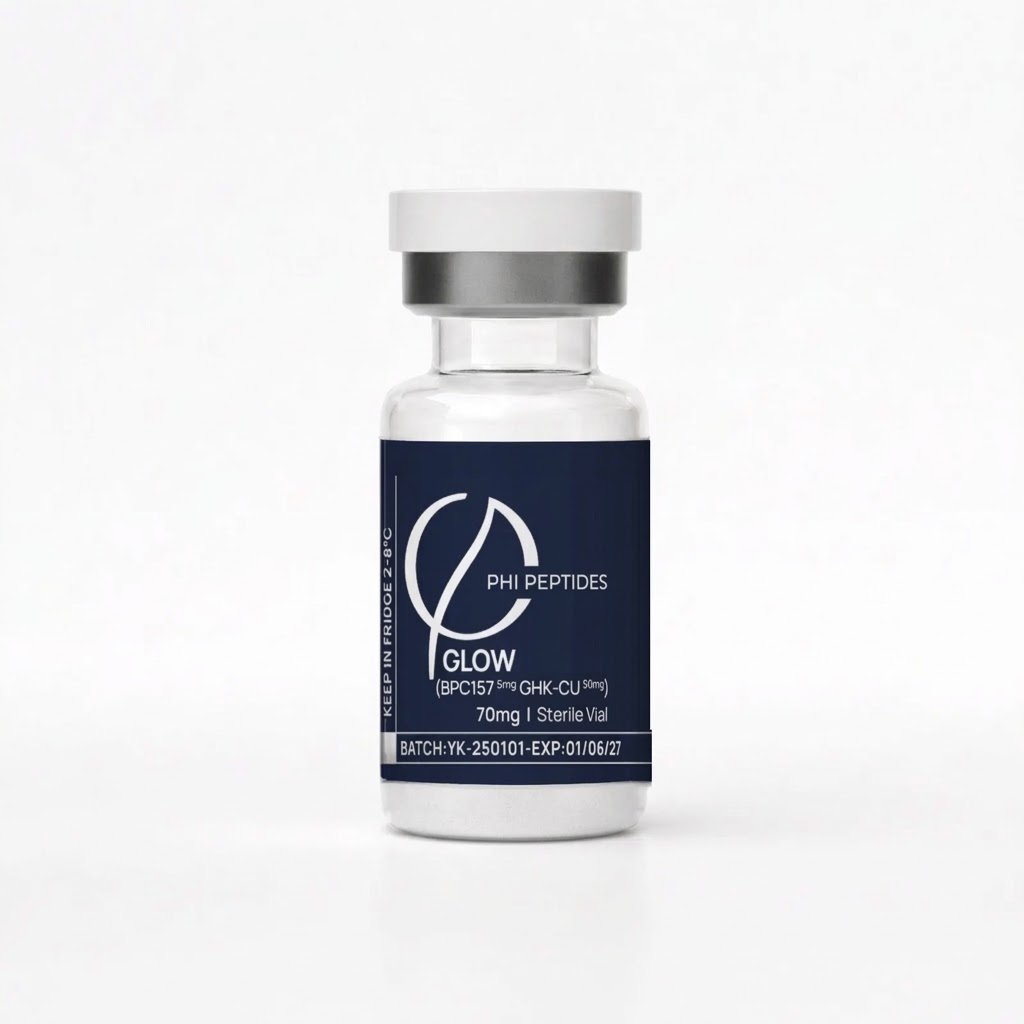
A fixed combination of BPC-157 and the copper tripeptide GHK-Cu, formulated around the overlap between connective-tissue repair and dermal renewal.
| Standard Delivery (Signed for) | Delivered within 3-5 working days |
| Express Delivery (Standard Parcels) | Delivered within 1-2 working days |
| Extra-Large Parcels (Signed for) | Delivered within 3-5 working days |
| Furniture | Delivery usually takes place within 2 weeks. |
Allow sealed vials to equilibrate to ambient laboratory temperature before opening. This helps minimise the risk of condensation forming within the vial. Keep unopened vials stored at 2-8 C, protected from direct light and moisture. All handling, storage after opening, and laboratory procedures should be carried out according to the receiving laboratory’s established protocols and applicable requirements.
GLOW combines two of the most studied regenerative peptides in a single presentation. BPC-157 contributes an angiogenic and soft-tissue remodelling profile drawn from a large preclinical literature; GHK-Cu contributes a copper-delivery and matrix-signalling profile with the strongest supporting evidence of the two, largely from topical dermatological research. The combination is positioned for practitioners working at the intersection of aesthetic and regenerative medicine. As with the individual components, the combination itself has not been studied in controlled human trials, and no interaction or synergy data exist. Practitioners choosing a fixed combination should be satisfied that both components are individually appropriate for the patient, since the ratio cannot be adjusted independently.
Active Compound: BPC-157 5 mg + GHK-Cu 50 mg (combination)
Permitted Claim GuidelinesA combination of two widely studied regenerative peptides. Used under practitioner supervision. The combination has not been evaluated in clinical trials.
Dual mechanism. BPC-157 promotes VEGFR2-mediated angiogenesis and organised granulation tissue formation. GHK-Cu acts as a copper carrier, modulating expression of genes governing collagen, elastin and glycosaminoglycan synthesis, and influencing matrix metalloproteinase and TIMP balance during remodelling.
Evidence Grade: D - Combination unstudied; component evidence preclinical to limited-human
Clinical Evidence BaseComponent-level evidence only. GHK-Cu has controlled human data in topical dermatological application. BPC-157 evidence is preclinical. The fixed combination has not been evaluated in any published human or animal study, and no synergy has been demonstrated.
Literature & ReferencesRefer to component literature for BPC-157 and GHK-Cu. No combination-specific literature exists. | Pickart L, Margolina A. Int J Mol Sci, 2018 - GHK-Cu biological actions. | Sikiric P et al. Curr Pharm Des, 2011 - BPC 157 overview.
Carries the combined precautions of both components. Copper content is the principal consideration: contraindicated in Wilson's disease and used with caution where copper handling may be impaired. Theoretical angiogenic concern in occult malignancy. Not for use in pregnancy or breastfeeding. Injection-site reactions and transient discolouration at the site have been reported with copper peptides.
ContraindicationsWilson's disease or other disorders of copper metabolism; active or suspected malignancy; pregnancy and breastfeeding; known hypersensitivity.
Storage & HandlingStore lyophilised vial at 2-8 C, protected from light. Copper peptides are light-sensitive; keep in outer carton.
Neither component is authorised as a medicine in the UK, EU or US. Fixed combinations may attract additional regulatory scrutiny in some jurisdictions. Supplied only through appropriate professional channels.