
Currently Empty: $0.00
Research only

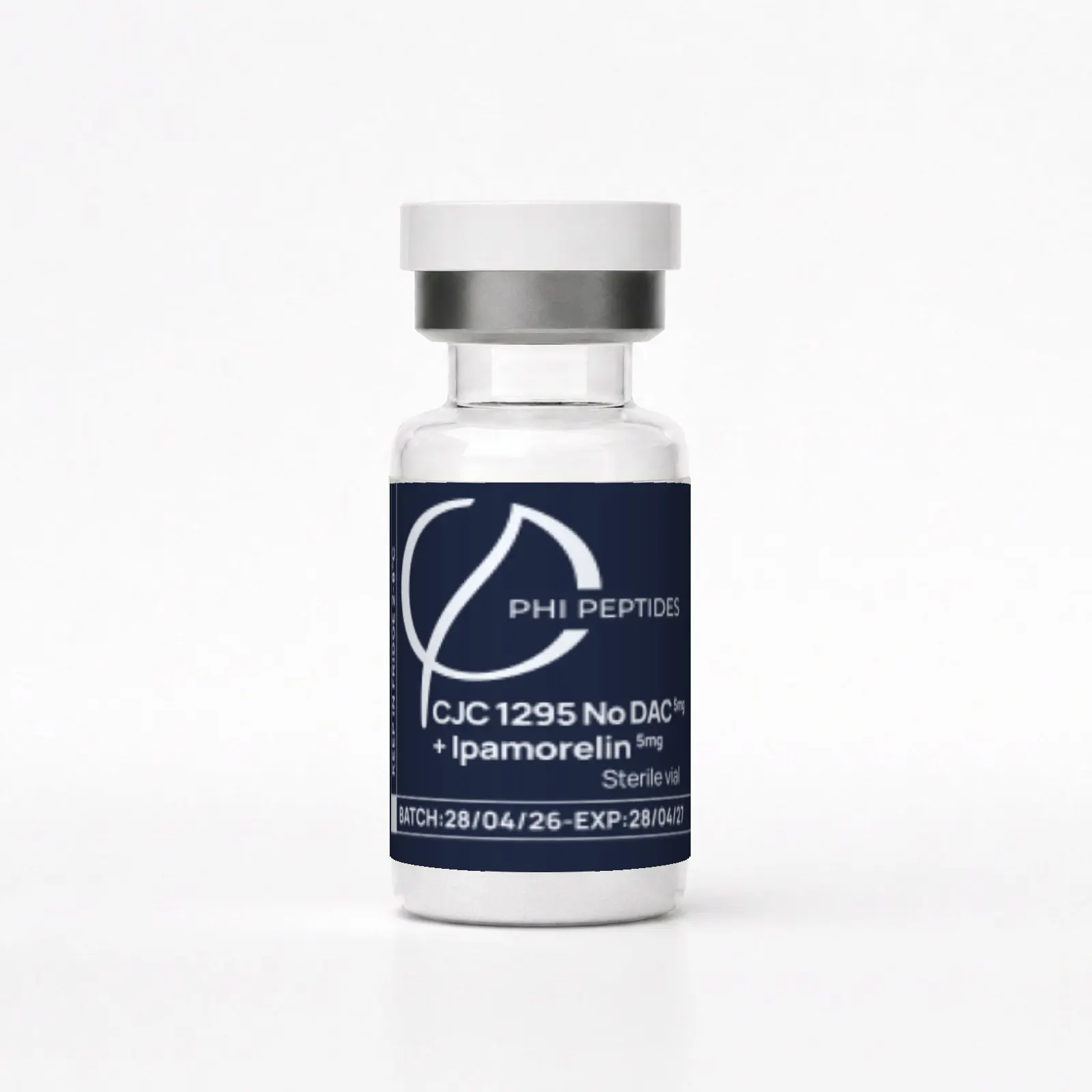
A paired GHRH analogue and selective ghrelin-receptor agonist, combined to act on two complementary arms of growth hormone regulation.
| Standard Delivery (Signed for) | Delivered within 3-5 working days |
| Express Delivery (Standard Parcels) | Delivered within 1-2 working days |
| Extra-Large Parcels (Signed for) | Delivered within 3-5 working days |
| Furniture | Delivery usually takes place within 2 weeks. |
Allow sealed vials to equilibrate to ambient laboratory temperature before opening. This helps minimise the risk of condensation forming within the vial. Keep unopened vials stored at 2-8 C, protected from direct light and moisture. All handling, storage after opening, and laboratory procedures should be carried out according to the receiving laboratory’s established protocols and applicable requirements.
This combination pairs a short-acting GHRH analogue with a selective growth hormone secretagogue. The rationale is mechanistic rather than empirical: CJC-1295 without DAC raises the amplitude of the growth hormone pulse via the GHRH receptor, while ipamorelin acts at the GHS-R1a receptor and additionally suppresses somatostatin tone. Because the DAC moiety is absent, the half-life is short and the natural pulsatile secretion pattern is broadly preserved, which is the principal argument advanced for this pairing over long-acting alternatives. Ipamorelin is notable for its selectivity – unlike earlier secretagogues it does not meaningfully raise cortisol or prolactin. The combination itself has not been evaluated in controlled human trials, and the components’ individual clinical development did not reach approval.
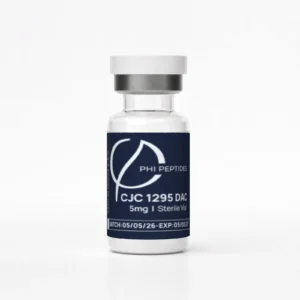
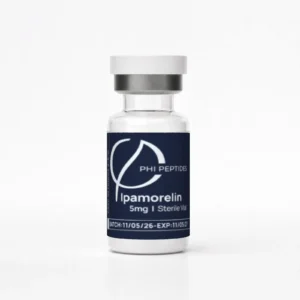
Active Compound: CJC-1295 without DAC (Mod GRF 1-29) 5 mg + Ipamorelin 5 mg
Permitted Claim GuidelinesA combination acting on two complementary growth hormone pathways. Used under practitioner supervision with appropriate endocrine monitoring.
Dual-pathway stimulation of pituitary somatotrophs. CJC-1295 without DAC binds the GHRH receptor to increase pulse amplitude. Ipamorelin binds the growth hormone secretagogue receptor (GHS-R1a), amplifying release and reducing somatostatin inhibition. The two pathways are additive in preclinical work.
Evidence Grade: C - Component human data available; combination not trialled
Clinical Evidence BaseComponent-level evidence only. Ipamorelin reached Phase III for postoperative ileus and did not meet its primary endpoint. GHRH analogue pharmacology is well characterised. No controlled human trial of the combination for body composition, recovery or longevity endpoints has been published.
Literature & ReferencesRaun K et al. Eur J Endocrinol, 1998 - ipamorelin, the first selective growth hormone secretagogue. | Beck DE et al. Am J Surg, 2014 - ipamorelin Phase III in postoperative ileus. | Teichman SL et al. J Clin Endocrinol Metab, 2006 - CJC-1295 endocrine effects.
Reported effects include injection-site reactions, transient flushing, headache, lightheadedness and increased appetite attributable to the ghrelin-receptor component. Fluid retention and arthralgia may occur with sustained GH elevation. Contraindicated where malignancy is present or suspected. IGF-1 monitoring is advised where use is continued.
ContraindicationsActive or suspected malignancy; pregnancy and breastfeeding; proliferative diabetic retinopathy; acute critical illness; known hypersensitivity.
Storage & HandlingStore lyophilised vial at 2-8 C, protected from light.
Neither component is authorised as a medicine. Both are prohibited in sport under the WADA Prohibited List (S2). Supplied only through appropriate professional, prescription-led channels.