
Currently Empty: $0.00
Research only

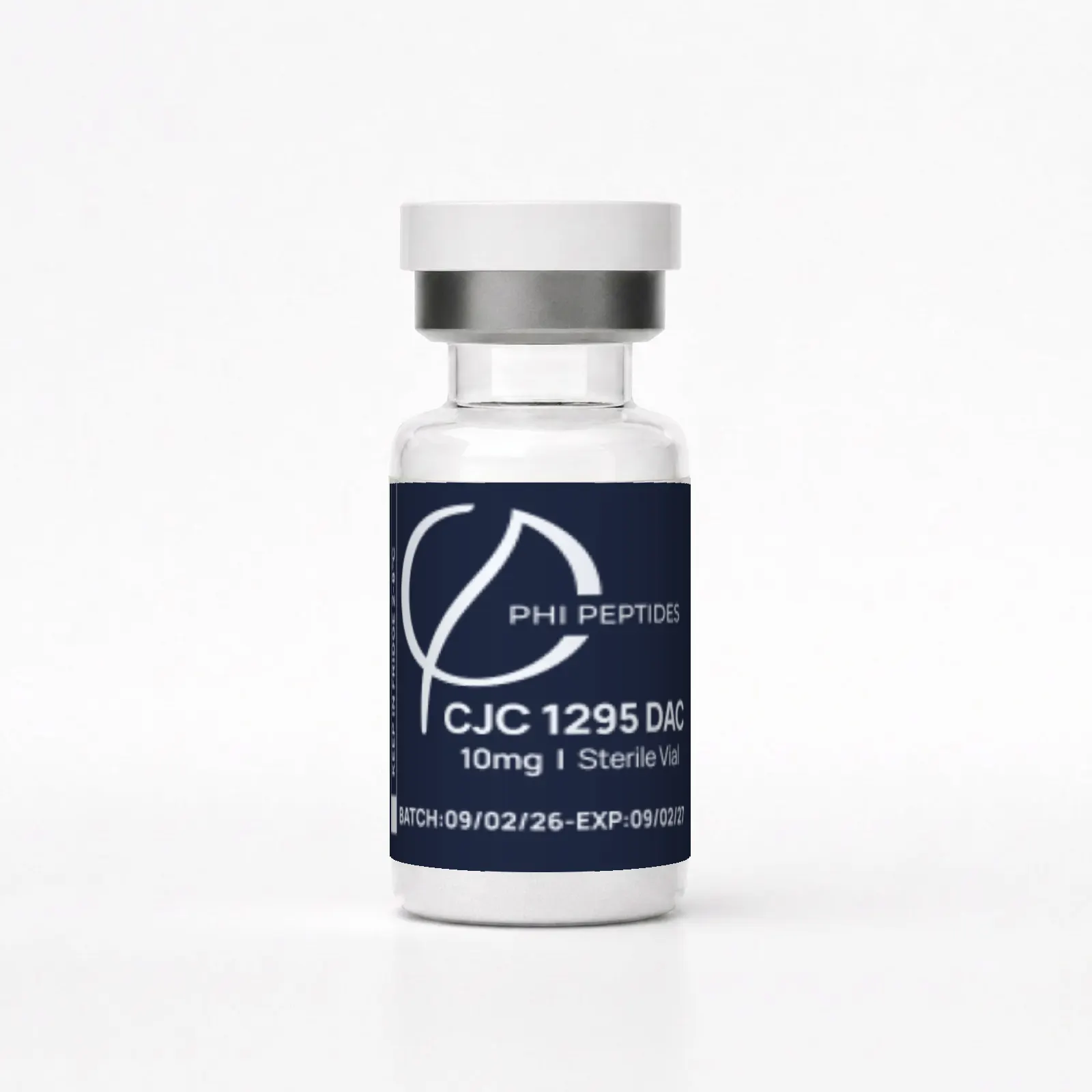
A long-acting analogue of growth hormone releasing hormone, engineered with a drug affinity complex to extend its half-life to several days.
| Standard Delivery (Signed for) | Delivered within 3-5 working days |
| Express Delivery (Standard Parcels) | Delivered within 1-2 working days |
| Extra-Large Parcels (Signed for) | Delivered within 3-5 working days |
| Furniture | Delivery usually takes place within 2 weeks. |
Allow sealed vials to equilibrate to ambient laboratory temperature before opening. This helps minimise the risk of condensation forming within the vial. Keep unopened vials stored at 2-8 C, protected from direct light and moisture. All handling, storage after opening, and laboratory procedures should be carried out according to the receiving laboratory’s established protocols and applicable requirements.
CJC-1295 with DAC is a modified GHRH(1-29) analogue. Four amino acid substitutions confer resistance to enzymatic degradation, and the drug affinity complex allows covalent binding to circulating albumin, extending the half-life from minutes to approximately six to eight days. The practical consequence is a sustained elevation in growth hormone and IGF-1 rather than the pulsatile pattern of endogenous secretion, which is both its principal convenience and its principal physiological criticism. Phase I human work established the pharmacokinetic and endocrine profile clearly. Clinical development was discontinued and the compound holds no marketing authorisation. Practitioners should note the distinction from CJC-1295 without DAC, which has a short half-life and a pulse-preserving profile; the two are frequently confused in the market.
Active Compound: CJC-1295 with DAC (drug affinity complex)
Permitted Claim GuidelinesA long-acting GHRH analogue characterised in Phase I human studies. Used under practitioner supervision with appropriate endocrine monitoring.
Binds the GHRH receptor on anterior pituitary somatotrophs, stimulating synthesis and release of growth hormone with consequent hepatic IGF-1 production. Albumin binding via the DAC moiety prevents renal clearance and enzymatic degradation, producing a continuous rather than pulsatile stimulus.
Evidence Grade: B - Phase I human pharmacokinetic and endocrine data; no efficacy trials
Clinical Evidence BasePhase I human studies demonstrated dose-dependent increases in growth hormone and IGF-1 sustained over several days, with acceptable short-term tolerability. No Phase II or III efficacy data for body composition, performance or longevity endpoints. Development was not continued.
Literature & ReferencesTeichman SL et al. J Clin Endocrinol Metab, 2006 - prolonged stimulation of GH and IGF-1 by CJC-1295. | Jette L et al. Endocrinology, 2005 - human GRF analogue with albumin-binding DAC. | Ionescu M, Frohman LA. J Clin Endocrinol Metab, 2006 - pulsatile secretion under continuous GHRH stimulation.
Reported effects include injection-site reactions, transient flushing, headache and fluid retention. Sustained non-pulsatile GH elevation raises theoretical concerns regarding insulin sensitivity, carpal tunnel symptoms and arthralgia, consistent with the known profile of growth hormone excess. Contraindicated where active malignancy is present or suspected, given IGF-1's mitogenic role. Baseline and periodic IGF-1 monitoring is advised in clinical use.
ContraindicationsActive or suspected malignancy; pregnancy and breastfeeding; proliferative diabetic retinopathy; acute critical illness; known hypersensitivity.
Storage & HandlingStore lyophilised vial at 2-8 C, protected from light.
Not authorised as a medicine in any major market. Prohibited in sport under the WADA Prohibited List (S2). Supplied only through appropriate professional, prescription-led channels with endocrine oversight.