
Currently Empty: $0.00
Research only

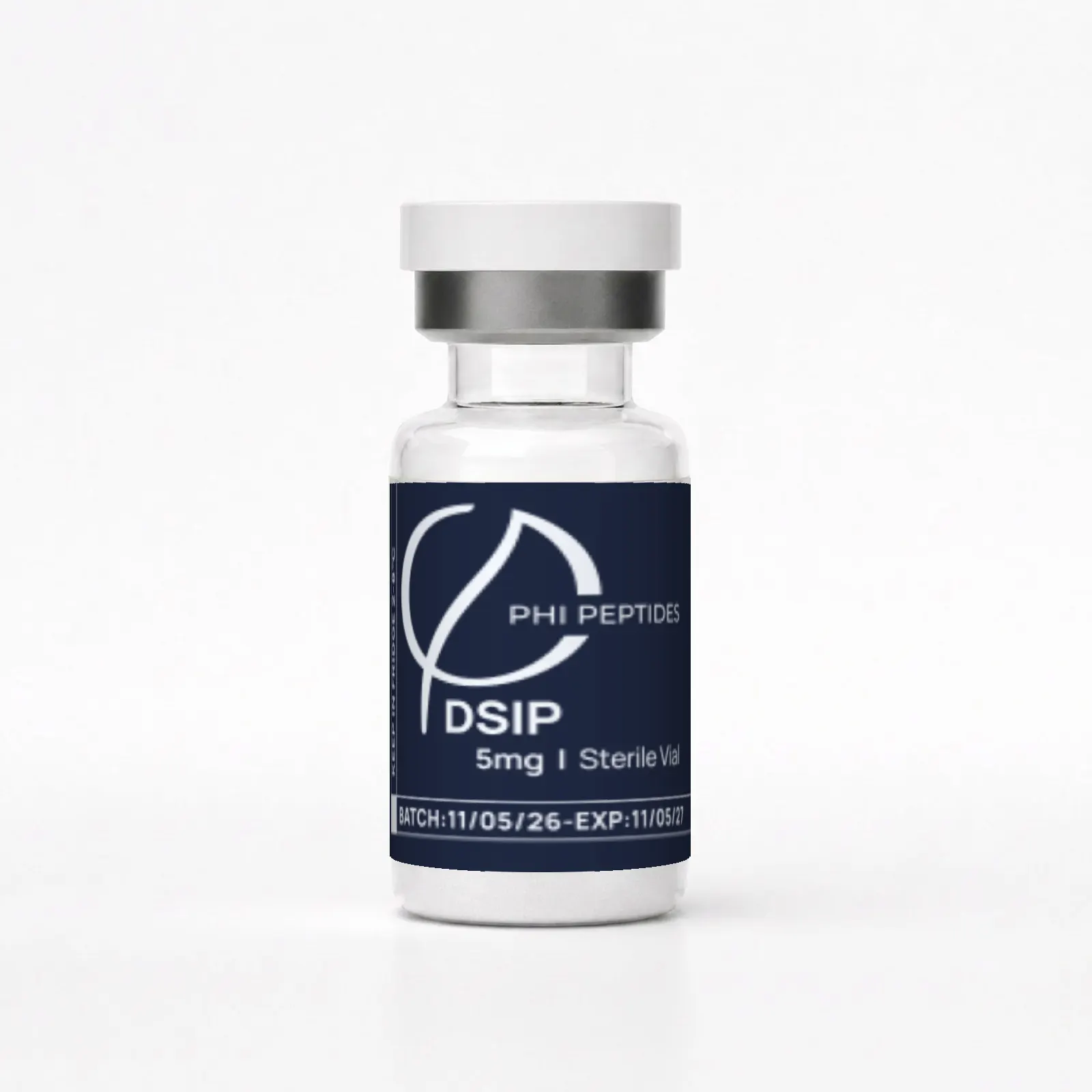
A nonapeptide first isolated from rabbit cerebral venous blood during induced sleep, investigated for its influence on sleep architecture and stress response.
| Standard Delivery (Signed for) | Delivered within 3-5 working days |
| Express Delivery (Standard Parcels) | Delivered within 1-2 working days |
| Extra-Large Parcels (Signed for) | Delivered within 3-5 working days |
| Furniture | Delivery usually takes place within 2 weeks. |
Allow sealed vials to equilibrate to ambient laboratory temperature before opening. This helps minimise the risk of condensation forming within the vial. Keep unopened vials stored at 2-8 C, protected from direct light and moisture. All handling, storage after opening, and laboratory procedures should be carried out according to the receiving laboratory’s established protocols and applicable requirements.
Delta sleep-inducing peptide was identified in the 1970s in the cerebral venous blood of rabbits during electrically induced sleep, and named for the delta-wave activity associated with its discovery. Subsequent investigation produced a mixed and often inconsistent picture: some small human studies reported improvements in sleep latency and subjective sleep quality in poor sleepers, while others found no reliable electroencephalographic effect. Interest has since broadened to include its apparent influence on the hypothalamic-pituitary-adrenal axis and on stress adaptation. The literature is small, dated, and largely produced before modern trial standards. PHI supplies DSIP for clinician-directed use, and practitioners should be candid with patients that the sleep evidence is suggestive rather than established.
Active Compound: Delta Sleep-Inducing Peptide (DSIP)
Permitted Claim GuidelinesInvestigated for its influence on sleep architecture and stress response. Used under practitioner supervision. Clinical evidence is limited and inconsistent.
Not definitively characterised and no specific receptor has been identified. Proposed actions include modulation of the hypothalamic-pituitary-adrenal axis with attenuation of corticotropin release, interaction with opioid and GABAergic systems, and influence on circadian regulation. The absence of a confirmed receptor is a significant gap in understanding.
Evidence Grade: C - Historic small human studies; inconsistent findings, no modern trials
Clinical Evidence BaseSmall human studies from the 1980s reported improved subjective sleep in chronic poor sleepers, but findings were inconsistent and objective polysomnographic confirmation was limited. No modern randomised controlled trials. Mechanistic understanding remains incomplete.
Literature & ReferencesSchoenenberger GA, Monnier M. Proc Natl Acad Sci USA, 1977 - isolation and characterisation of DSIP. | Schneider-Helmert D, Schoenenberger GA. Experientia, 1983 - effects on disturbed sleep. | Kovalzon VM, Strekalova TV. Neurosci Behav Physiol, 2006 - critical review of DSIP function.
Limited safety data. Reported as well tolerated in the small studies conducted, with injection-site reactions the most commonly noted effect. Because the mechanism is uncharacterised, interaction potential with sedatives, opioids and psychotropic medicines is unknown and caution is warranted. Not for use in pregnancy or breastfeeding. Patients should be counselled not to substitute it for assessment of an underlying sleep disorder such as obstructive sleep apnoea.
ContraindicationsPregnancy and breastfeeding; concurrent sedative or opioid therapy without review; undiagnosed sleep-disordered breathing; known hypersensitivity.
Storage & HandlingStore lyophilised vial at 2-8 C, protected from light.
Not authorised as a medicine in the UK, EU or US. Supplied only through appropriate professional, prescription-led channels.