
Currently Empty: $0.00
Research only

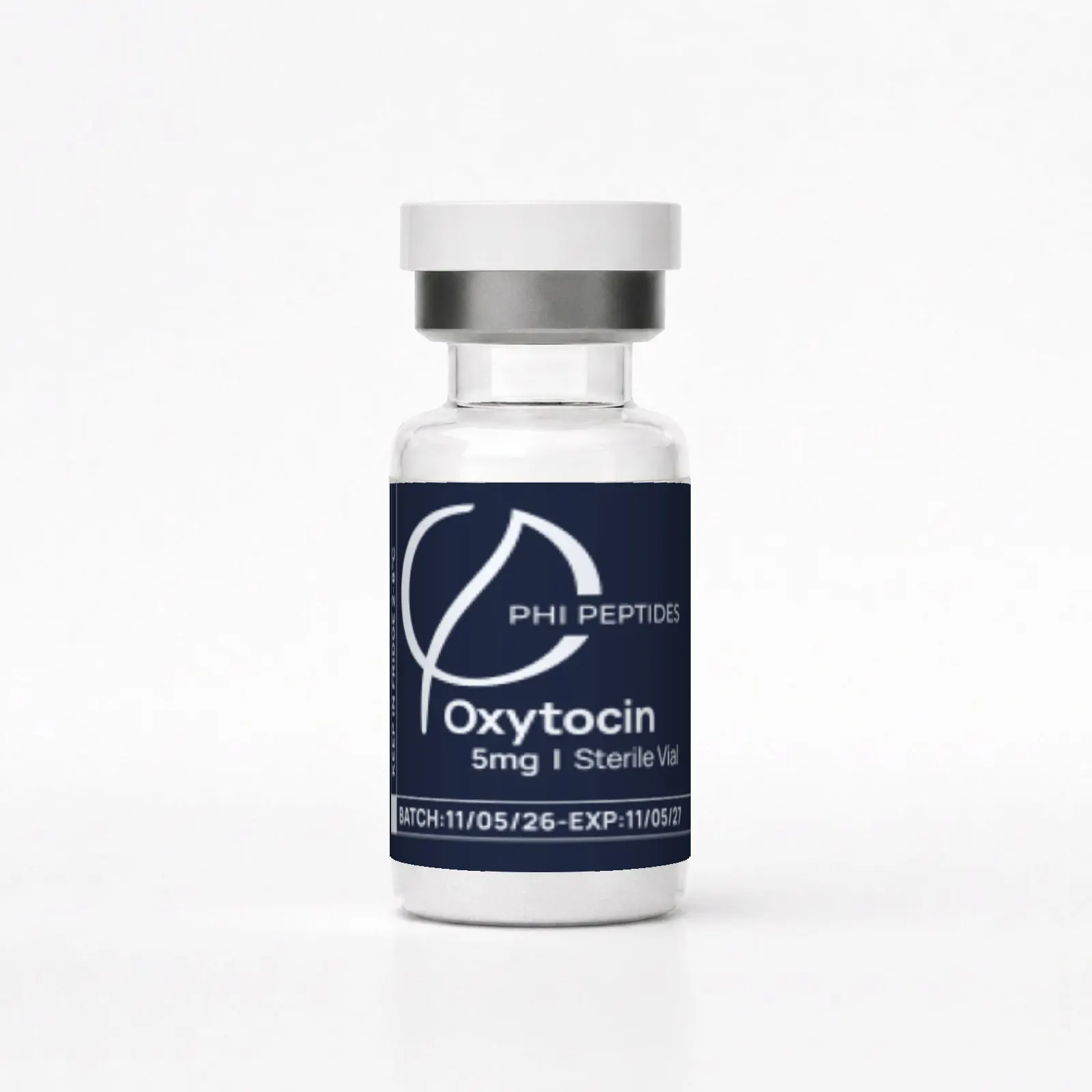
A well-characterised endogenous nonapeptide hormone, licensed for obstetric indications and studied extensively for its effects on social and emotional processing.
| Standard Delivery (Signed for) | Delivered within 3-5 working days |
| Express Delivery (Standard Parcels) | Delivered within 1-2 working days |
| Extra-Large Parcels (Signed for) | Delivered within 3-5 working days |
| Furniture | Delivery usually takes place within 2 weeks. |
Allow sealed vials to equilibrate to ambient laboratory temperature before opening. This helps minimise the risk of condensation forming within the vial. Keep unopened vials stored at 2-8 C, protected from direct light and moisture. All handling, storage after opening, and laboratory procedures should be carried out according to the receiving laboratory’s established protocols and applicable requirements.
Oxytocin is a naturally occurring nonapeptide synthesised in the hypothalamus and released from the posterior pituitary. It is a licensed medicine in every major market for obstetric indications, and its pharmacology and safety profile in that context are thoroughly established. The use represented here is different: a substantial academic literature, mostly using intranasal administration, has examined its effects on trust, social cognition, anxiety and pair bonding. That literature is large but its reliability is actively debated, with meta-analyses producing inconsistent conclusions and significant concerns raised about replication and about how much intranasally administered oxytocin reaches the central nervous system. Practitioners should be aware that this SKU sits in an unusual regulatory position: the molecule is a licensed medicine, but the use contemplated here is off-label.
Active Compound: Oxytocin
Permitted Claim GuidelinesA prescription-only medicine licensed for obstetric use. Supplied on prescription. Any other use is off-label and at the discretion of the prescribing clinician.
Binds the oxytocin receptor, a G-protein coupled receptor expressed in uterine smooth muscle, mammary myoepithelium and multiple central nervous system regions including the amygdala, hypothalamus and nucleus accumbens. Central effects are thought to involve modulation of amygdala reactivity and dopaminergic reward signalling. Peripheral administration raises the question of how much crosses the blood-brain barrier.
Evidence Grade: A (licensed obstetric use) / C (off-label behavioural use, contested evidence)
Clinical Evidence BaseRobust trial evidence and marketing authorisation for obstetric indications. For social, emotional and anxiety-related applications, a large but heterogeneous body of academic research exists with meaningful replication concerns; meta-analyses have not established consistent effects. Use for these purposes is off-label.
Literature & ReferencesKosfeld M et al. Nature, 2005 - oxytocin increases trust in humans. | MacDonald E et al. Psychoneuroendocrinology, 2011 - safety review of intranasal oxytocin. | Leng G, Ludwig M. Biol Psychiatry, 2016 - intranasal oxytocin, a critical appraisal. | Walum H, Waldman ID, Young LJ. Biol Psychiatry, 2016 - statistical and methodological considerations.
Well characterised. The most serious risk with repeated or high-dose administration is water intoxication and hyponatraemia, owing to antidiuretic activity - this is a genuine and documented hazard, not a theoretical one, and fluid intake must be discussed. Other effects include nausea, headache and, at higher doses, cardiovascular effects including tachycardia and hypotension. Contraindicated in pregnancy other than under obstetric supervision, since it stimulates uterine contraction. Caution with concurrent medicines affecting sodium or fluid balance.
ContraindicationsPregnancy (outside obstetric supervision); hyponatraemia or conditions predisposing to it; significant cardiovascular disease; known hypersensitivity. Caution with diuretics and other agents affecting fluid balance.
Storage & HandlingStore lyophilised vial at 2-8 C, protected from light. Do not freeze.
A licensed medicine for obstetric indications in all major markets; prescription-only. Use for social, emotional or wellbeing purposes is off-label and must be documented as such by the prescribing clinician. Note that the presentation and route supplied here differ from the licensed product.