
Currently Empty: $0.00
Research only

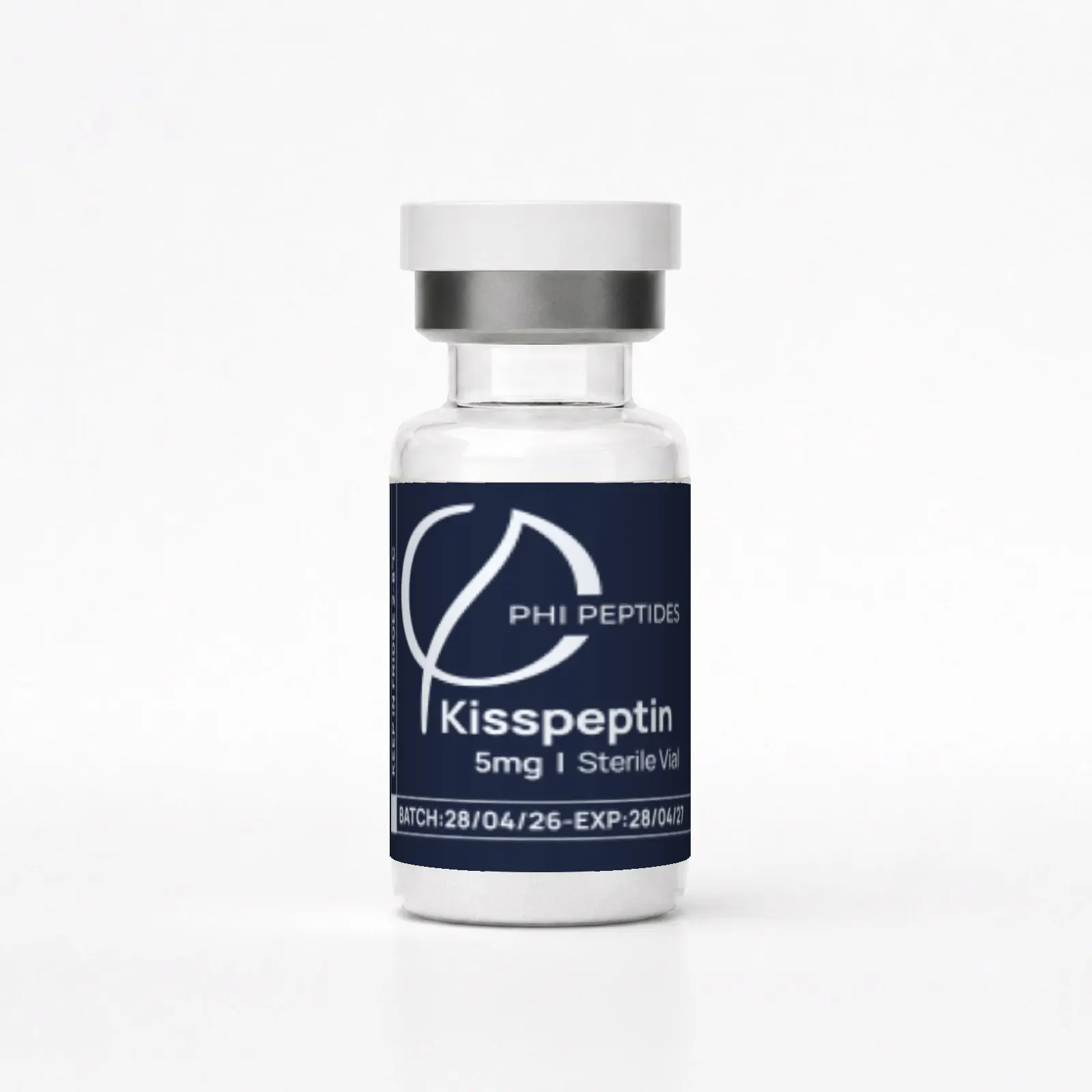
An endogenous neuropeptide that sits at the apex of reproductive endocrine control, with a substantial and growing human research literature.
| Standard Delivery (Signed for) | Delivered within 3-5 working days |
| Express Delivery (Standard Parcels) | Delivered within 1-2 working days |
| Extra-Large Parcels (Signed for) | Delivered within 3-5 working days |
| Furniture | Delivery usually takes place within 2 weeks. |
Allow sealed vials to equilibrate to ambient laboratory temperature before opening. This helps minimise the risk of condensation forming within the vial. Keep unopened vials stored at 2-8 C, protected from direct light and moisture. All handling, storage after opening, and laboratory procedures should be carried out according to the receiving laboratory’s established protocols and applicable requirements.
Kisspeptin is the product of the KISS1 gene and the principal upstream regulator of gonadotropin-releasing hormone secretion. Its discovery reframed the understanding of reproductive endocrinology: loss-of-function mutations in its receptor cause hypogonadotropic hypogonadism, establishing its role as essential rather than modulatory. It is among the better-evidenced compounds in this portfolio, with a genuine body of human physiological research from established academic centres, including work on gonadotropin response, fertility treatment protocols, and more recently on sexual and emotional brain processing. It is nonetheless an investigational agent; no kisspeptin product holds a marketing authorisation. PHI supplies Kisspeptin-10 for clinician-directed use in an appropriate endocrine or reproductive context.
Active Compound: Kisspeptin-10 (metastin fragment 45-54)
Permitted Claim GuidelinesAn endogenous regulator of the reproductive endocrine axis, studied in human physiological research. Used under practitioner supervision.
Binds the KISS1R (GPR54) receptor on hypothalamic GnRH neurons, triggering GnRH release and consequent pituitary secretion of luteinising hormone and follicle-stimulating hormone. This drives downstream gonadal steroidogenesis. Central kisspeptin signalling also appears to influence sexual and emotional processing independent of the gonadotropin axis.
Evidence Grade: B - Consistent human physiological and early clinical trial data
Clinical Evidence BaseMultiple human physiological studies from academic centres demonstrate reliable, dose-dependent gonadotropin responses. Investigated as a trigger in assisted reproduction protocols with promising results. Functional imaging studies report effects on sexual and emotional brain processing. No approved product; efficacy for libido or fertility as a standalone therapy is not established.
Literature & ReferencesDhillo WS et al. J Clin Endocrinol Metab, 2005 - kisspeptin-54 stimulates the hypothalamic-pituitary-gonadal axis in men. | Jayasena CN et al. J Clin Invest, 2014 - kisspeptin as a trigger of oocyte maturation in IVF. | Comninos AN et al. J Clin Invest, 2017 - kisspeptin modulates sexual and emotional brain processing. | de Roux N et al. Proc Natl Acad Sci USA, 2003 - hypogonadotropic hypogonadism due to GPR54 loss.
Well tolerated in published human studies at investigational doses, with no serious adverse events reported. Sustained or high-dose exposure can cause receptor desensitisation with paradoxical suppression of the gonadotropic axis - an important consideration for dosing frequency. Not for use in pregnancy. Contraindicated in hormone-sensitive malignancy. Effects on the reproductive axis warrant baseline and follow-up hormonal assessment.
ContraindicationsHormone-sensitive malignancy; pregnancy and breastfeeding; known hypersensitivity. Caution in any condition where gonadotropin stimulation is undesirable.
Storage & HandlingStore lyophilised vial at 2-8 C, protected from light.
Not authorised as a medicine in the UK, EU or US; investigational status. Supplied only through appropriate professional, prescription-led channels with endocrine or reproductive medicine oversight.