
Currently Empty: $0.00
Research only

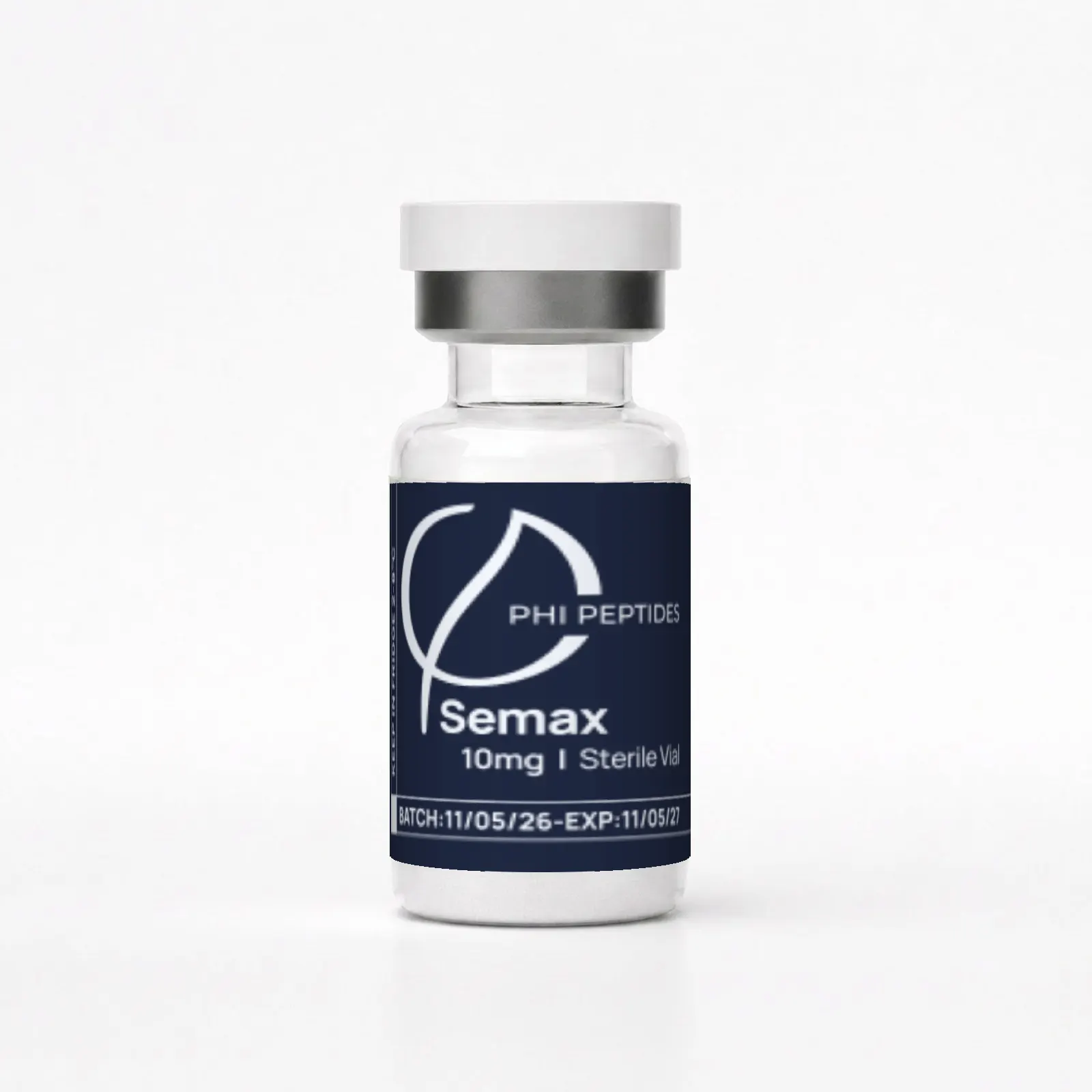
A synthetic analogue of a fragment of adrenocorticotropic hormone, registered in Russia and studied for neuroprotective and cognitive effects without hormonal activity.
| Standard Delivery (Signed for) | Delivered within 3-5 working days |
| Express Delivery (Standard Parcels) | Delivered within 1-2 working days |
| Extra-Large Parcels (Signed for) | Delivered within 3-5 working days |
| Furniture | Delivery usually takes place within 2 weeks. |
Allow sealed vials to equilibrate to ambient laboratory temperature before opening. This helps minimise the risk of condensation forming within the vial. Keep unopened vials stored at 2-8 C, protected from direct light and moisture. All handling, storage after opening, and laboratory procedures should be carried out according to the receiving laboratory’s established protocols and applicable requirements.
Semax is a synthetic heptapeptide based on the 4-10 fragment of adrenocorticotropic hormone, modified with a proline-glycine-proline extension for metabolic stability. The parent fragment retains the neurotropic properties of ACTH while lacking its adrenocorticotropic hormonal activity, which is the basis of the design. It is registered in Russia, where it has been used in the context of ischaemic stroke, cognitive disorders and optic nerve conditions. The most substantial claims relate to neuroprotection, supported by clinical work in acute stroke conducted within the Russian system. As with Selank, the essential caveat is that this evidence sits outside the Western regulatory process and has not been independently replicated. It holds no authorisation in the UK, EU or US.
Active Compound: Semax (Met-Glu-His-Phe-Pro-Gly-Pro, ACTH 4-10 analogue)
Permitted Claim GuidelinesA peptide registered as a medicine in Russia and studied for neuroprotective and cognitive effects. Used under practitioner supervision. Not authorised in this market.
Reported to increase expression of brain-derived neurotrophic factor and nerve growth factor, modulate monoaminergic transmission, and influence the expression of genes associated with neuroprotection, inflammation and vascular response. The proline-glycine-proline extension confers resistance to peptidase degradation. Melanocortin receptor involvement has been proposed but is not established.
Evidence Grade: B/C - Registered medicine in Russia with national trial data; not independently replicated
Clinical Evidence BaseRussian clinical trials report benefit in acute ischaemic stroke and in cognitive disorders, supporting national registration. Preclinical neuroprotection data are consistent. No independent replication outside Russia; no Western regulatory submission or approval.
Literature & ReferencesGusev EI et al. Zh Nevrol Psikhiatr, 2005 - Semax in acute ischaemic stroke. | Dolotov OV et al. J Neurochem, 2006 - Semax and BDNF expression in rat brain. | Ashmarin IP et al. Neurosci Behav Physiol, 1997 - design and neurotropic activity of ACTH 4-10 analogues.
Reported as well tolerated, without the hormonal effects of the parent ACTH molecule. Independent long-term safety data are not available. Reported effects are mild and include nasal irritation with the intranasal route. Not for use in pregnancy or breastfeeding. Patients with cognitive or neurological symptoms should be properly assessed rather than treated empirically.
ContraindicationsPregnancy and breastfeeding; acute psychiatric illness; known hypersensitivity. Undiagnosed neurological symptoms require assessment first.
Storage & HandlingStore lyophilised vial at 2-8 C, protected from light. Nasal presentation: store per device specification.
Registered as a medicine in the Russian Federation. Not authorised in the UK, EU or US. Supplied only through appropriate professional, prescription-led channels.