
Currently Empty: $0.00
Research only

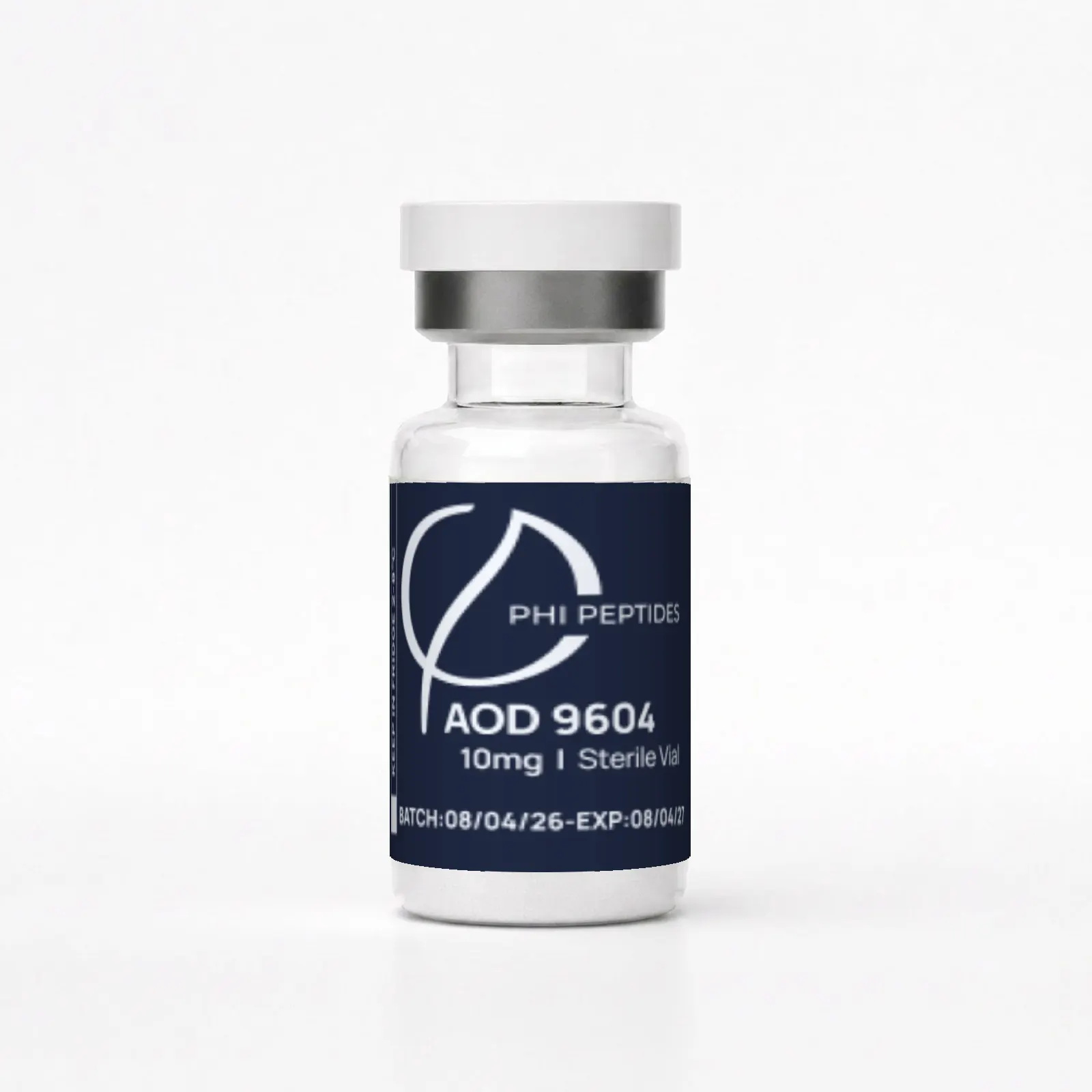
A synthetic fragment of human growth hormone studied for its effect on fat metabolism without the glucose effects of full-length HGH.
| Standard Delivery (Signed for) | Delivered within 3-5 working days |
| Express Delivery (Standard Parcels) | Delivered within 1-2 working days |
| Extra-Large Parcels (Signed for) | Delivered within 3-5 working days |
| Furniture | Delivery usually takes place within 2 weeks. |
Allow sealed vials to equilibrate to ambient laboratory temperature before opening. This helps minimise the risk of condensation forming within the vial. Keep unopened vials stored at 2-8 C, protected from direct light and moisture. All handling, storage after opening, and laboratory procedures should be carried out according to the receiving laboratory’s established protocols and applicable requirements.
AOD-9604 is a modified fragment corresponding to the C-terminal region (amino acids 176-191) of human growth hormone. It was developed specifically to isolate the lipolytic portion of the hGH molecule from the segments responsible for growth-promoting and insulin-antagonising activity. Preclinical work has focused on adipose tissue metabolism and, separately, on chondrocyte and cartilage biology. Human clinical development in obesity advanced to Phase II but did not demonstrate a significant weight-loss advantage over placebo, and the compound was not taken forward as an approved medicine. It continues to be used within performance and longevity practice under clinician direction, and PHI supplies it on that basis. Practitioners should present it to patients as an investigational compound with a favourable tolerability profile but an unproven efficacy signal in humans.
Active Compound: AOD-9604 (hGH fragment 176-191)
Permitted Claim GuidelinesStudied for its role in fat metabolism. Used in clinical practice under practitioner supervision. Human efficacy for weight loss is not established.
Believed to stimulate lipolysis and inhibit lipogenesis in adipose tissue through a beta-3 adrenergic-linked pathway, independent of the growth hormone receptor. Because it lacks the residues required for IGF-1 induction, it does not raise IGF-1 or impair insulin sensitivity in the manner of full-length growth hormone. Separate preclinical work suggests an anabolic effect on chondrocytes.
Evidence Grade: C - Human trials conducted; efficacy endpoint not met
Clinical Evidence BasePreclinical rodent data support the lipolytic mechanism. Human Phase II obesity trials showed the compound to be well tolerated but did not meet weight-loss endpoints against placebo. Safety has been reviewed favourably in a published toxicology and clinical safety assessment. No regulatory approval for any indication.
Literature & ReferencesHeffernan MA et al. Endocrinology, 2001 - lipolytic activity of hGH 177-191. | Stier H et al. Journal of Obesity, 2013 - safety and toxicology review of AOD-9604. | Ng FM et al. Horm Res, 2000 - antilipogenic action of hGH fragments.
Generally well tolerated in trials, with adverse events comparable to placebo. Does not appear to raise IGF-1 or affect glucose tolerance. Not to be used in pregnancy or breastfeeding. Caution in active malignancy. Injection-site reactions are the most commonly reported event. Patients should be advised that human efficacy data are not supportive and that clinical benefit is not established.
ContraindicationsPregnancy and breastfeeding; active or recent malignancy; known hypersensitivity. Paediatric use not appropriate.
Storage & HandlingStore lyophilised vial at 2-8 C, protected from light. Do not freeze after reconstitution.
Not authorised as a medicine in the UK, EU or US. Prohibited in sport under the WADA Prohibited List (S2). Supply is limited to appropriate professional and prescription-led channels where the local framework permits.