
Currently Empty: $0.00
Research only

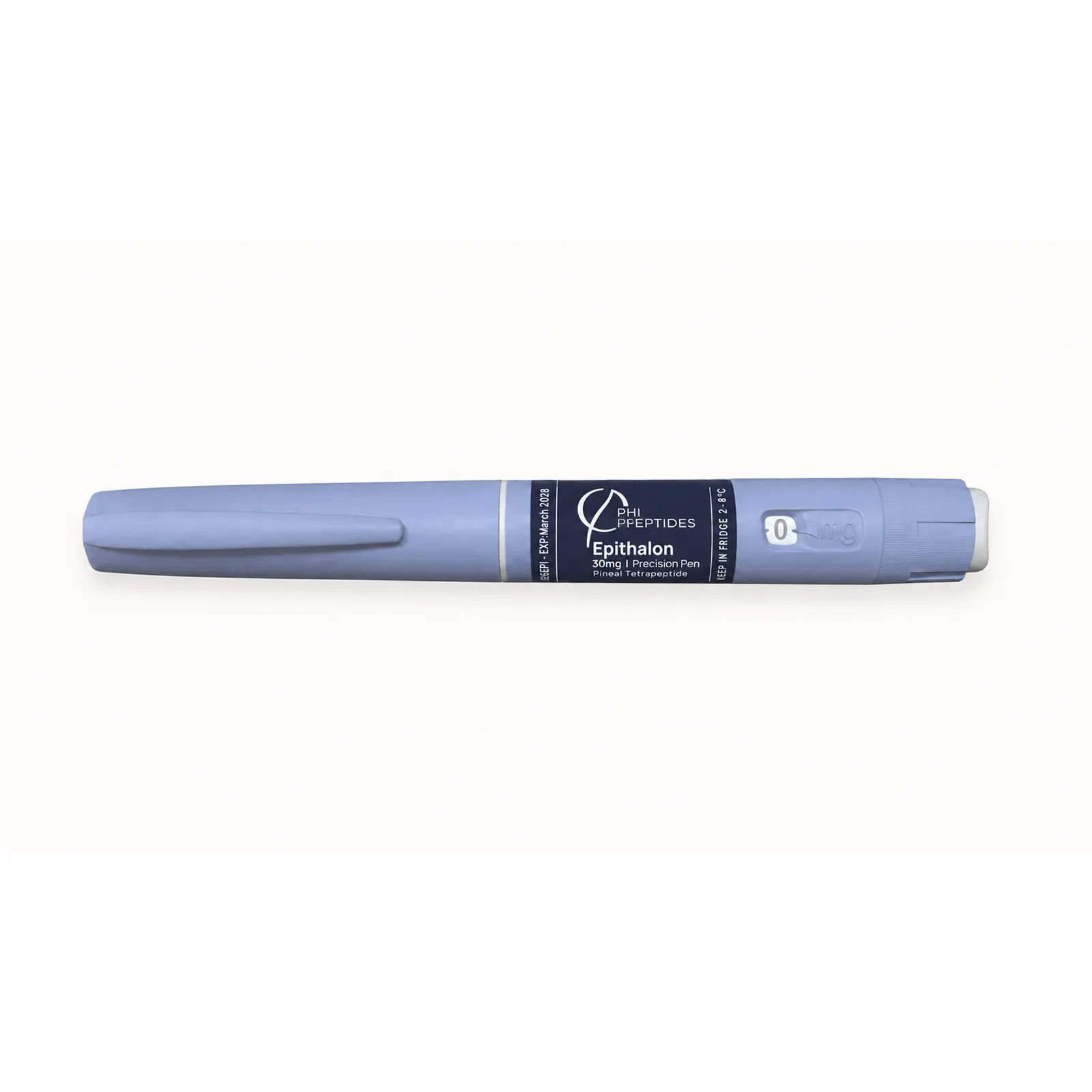
A synthetic tetrapeptide modelled on a pineal gland extract, studied in Russian research programmes for its effects on telomerase activity and ageing markers.
| Standard Delivery (Signed for) | Delivered within 3-5 working days |
| Express Delivery (Standard Parcels) | Delivered within 1-2 working days |
| Extra-Large Parcels (Signed for) | Delivered within 3-5 working days |
| Furniture | Delivery usually takes place within 2 weeks. |
Allow sealed vials to equilibrate to ambient laboratory temperature before opening. This helps minimise the risk of condensation forming within the vial. Keep unopened vials stored at 2-8 C, protected from direct light and moisture. All handling, storage after opening, and laboratory procedures should be carried out according to the receiving laboratory’s established protocols and applicable requirements.
Epithalon is a four-amino-acid peptide developed from Epithalamin, a pineal gland extract investigated in Soviet and Russian gerontology programmes from the 1970s onward. The associated research reports effects on melatonin rhythm, telomerase expression in cultured human fibroblasts, and lifespan and tumour incidence in rodent models. It is the most frequently cited compound in the longevity peptide category and also one of the most methodologically contested: the majority of the supporting literature originates from a single institutional group, much of it published in Russian-language journals, and independent replication is scarce. PHI supplies Epithalon for clinician-directed use. Practitioners should present the telomerase and lifespan findings accurately as laboratory and animal observations, not as demonstrated human outcomes.
Active Compound: Epithalon / Epitalon (Ala-Glu-Asp-Gly)
Permitted Claim GuidelinesStudied for its effects on telomerase activity in cell culture and on ageing markers in animal models. Used under practitioner supervision. Human evidence is limited.
Proposed to act at the level of gene expression, with reported induction of telomerase reverse transcriptase (TERT) in cultured somatic cells and restoration of pineal melatonin rhythmicity in aged animals. A specific receptor has not been identified; a direct interaction with promoter regions of DNA has been proposed but is not established.
Evidence Grade: D - In vitro and rodent data; human evidence limited and not independently replicated
Clinical Evidence BaseIn vitro induction of telomerase in human fibroblast culture has been reported. Rodent studies report increased lifespan and reduced spontaneous tumour incidence. Human data consist of small, largely uncontrolled observational series from a single research tradition. No independent randomised controlled trials exist.
Literature & ReferencesKhavinson VK et al. Bull Exp Biol Med, 2003 - epithalon peptide induces telomerase activity in human somatic cells. | Anisimov VN et al. Biogerontology, 2003 - effect of Epitalon on lifespan and tumour incidence in mice. | Khavinson VK, Morozov VG. Neuroendocrinol Lett, 2003 - peptides of the pineal gland and ageing.
No significant toxicity has been reported in the available studies, but the absence of independent human safety data means the long-term profile is unknown. The theoretical concern with any telomerase-modulating agent is its effect in the presence of occult malignancy, and this has not been resolved. Not for use in pregnancy or breastfeeding. Injection-site reactions are the most commonly reported effect.
ContraindicationsActive or suspected malignancy; pregnancy and breastfeeding; known hypersensitivity.
Storage & HandlingStore lyophilised vial at 2-8 C, protected from light.
Not authorised as a medicine in the UK, EU or US. Supplied only through appropriate professional, prescription-led channels.