
Currently Empty: $0.00
Research only

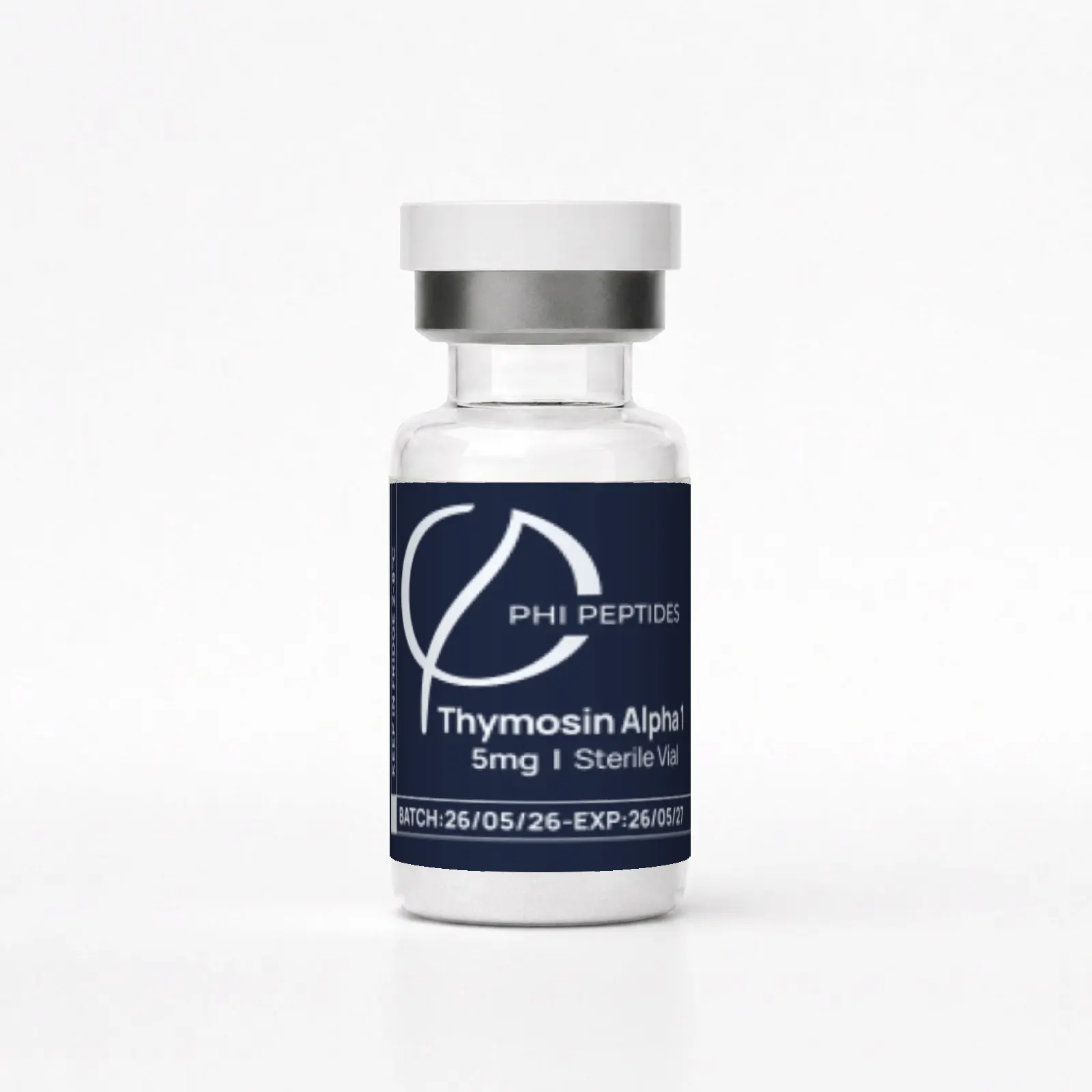
A naturally occurring thymic peptide licensed as a medicine in more than thirty countries, with the broadest formal regulatory footprint in this portfolio.
| Standard Delivery (Signed for) | Delivered within 3-5 working days |
| Express Delivery (Standard Parcels) | Delivered within 1-2 working days |
| Extra-Large Parcels (Signed for) | Delivered within 3-5 working days |
| Furniture | Delivery usually takes place within 2 weeks. |
Allow sealed vials to equilibrate to ambient laboratory temperature before opening. This helps minimise the risk of condensation forming within the vial. Keep unopened vials stored at 2-8 C, protected from direct light and moisture. All handling, storage after opening, and laboratory procedures should be carried out according to the receiving laboratory’s established protocols and applicable requirements.
Thymosin alpha-1 is a 28-amino-acid peptide originally isolated from thymic tissue, where it functions in the maturation and regulation of T lymphocytes. It is marketed as thymalfasin under the brand Zadaxin and holds marketing authorisation in a substantial number of countries – though not in the United States, United Kingdom or European Union – principally as an adjunct in chronic hepatitis B and C and as an immune adjuvant in sepsis and vaccination. It attracted renewed research attention during the COVID-19 pandemic. Its distinguishing feature within this range is that it is a genuine registered medicine with an established manufacturing and pharmacovigilance history in the markets where it is approved. Use outside those approved indications remains off-label.
Active Compound: Thymosin Alpha-1 (thymalfasin)
Permitted Claim GuidelinesA thymic peptide licensed as a medicine in a number of countries and studied as an immune modulator. Supplied on prescription for practitioner-directed use.
Acts principally on T-cell maturation and function, promoting differentiation of thymocytes and modulating the balance of T-helper subsets. Signals through Toll-like receptors, particularly TLR9 and TLR2, on dendritic cells and monocytes, enhancing antigen presentation. Increases natural killer cell activity and modulates cytokine production, with a regulatory rather than uniformly stimulatory effect.
Evidence Grade: A (licensed indications in approving markets) / C (off-label general immune use)
Clinical Evidence BaseRegistered medicine in over thirty countries with supporting trial evidence in chronic hepatitis B and C as adjunctive therapy, and in sepsis. Systematic reviews report benefit in specific populations. Evidence for general immune support, fatigue or longevity indications is absent.
Literature & ReferencesGaraci E et al. Ann N Y Acad Sci, 2012 - thymosin alpha-1, from bench to bedside. | Matteucci C et al. Expert Opin Biol Ther, 2017 - thymosin alpha-1 mechanisms and clinical application. | Wu J et al. Crit Care, 2013 - thymosin alpha-1 therapy in severe sepsis, a randomised controlled trial. | Liu Y et al. Int Immunopharmacol, 2016 - thymalfasin in chronic hepatitis B, meta-analysis.
Well tolerated in clinical use, with injection-site reactions the most commonly reported effect; transient discomfort, erythema and rarely mild fever have been described. Because it is immunomodulatory, caution is required in autoimmune disease and in transplant recipients or others on immunosuppressive therapy, where specialist review is appropriate. Not for use in pregnancy or breastfeeding. It should not be used in place of assessment for an underlying cause of recurrent infection or fatigue.
ContraindicationsOrgan transplant recipients and others on immunosuppressive therapy without specialist review; active autoimmune disease; pregnancy and breastfeeding; known hypersensitivity.
Storage & HandlingStore lyophilised vial at 2-8 C, protected from light.
Authorised as a medicine (thymalfasin) in more than thirty countries but not in the US, UK or EU. Supplied only through appropriate professional, prescription-led channels. Use outside licensed indications is off-label.