

Currently Empty: $0.00
Research only

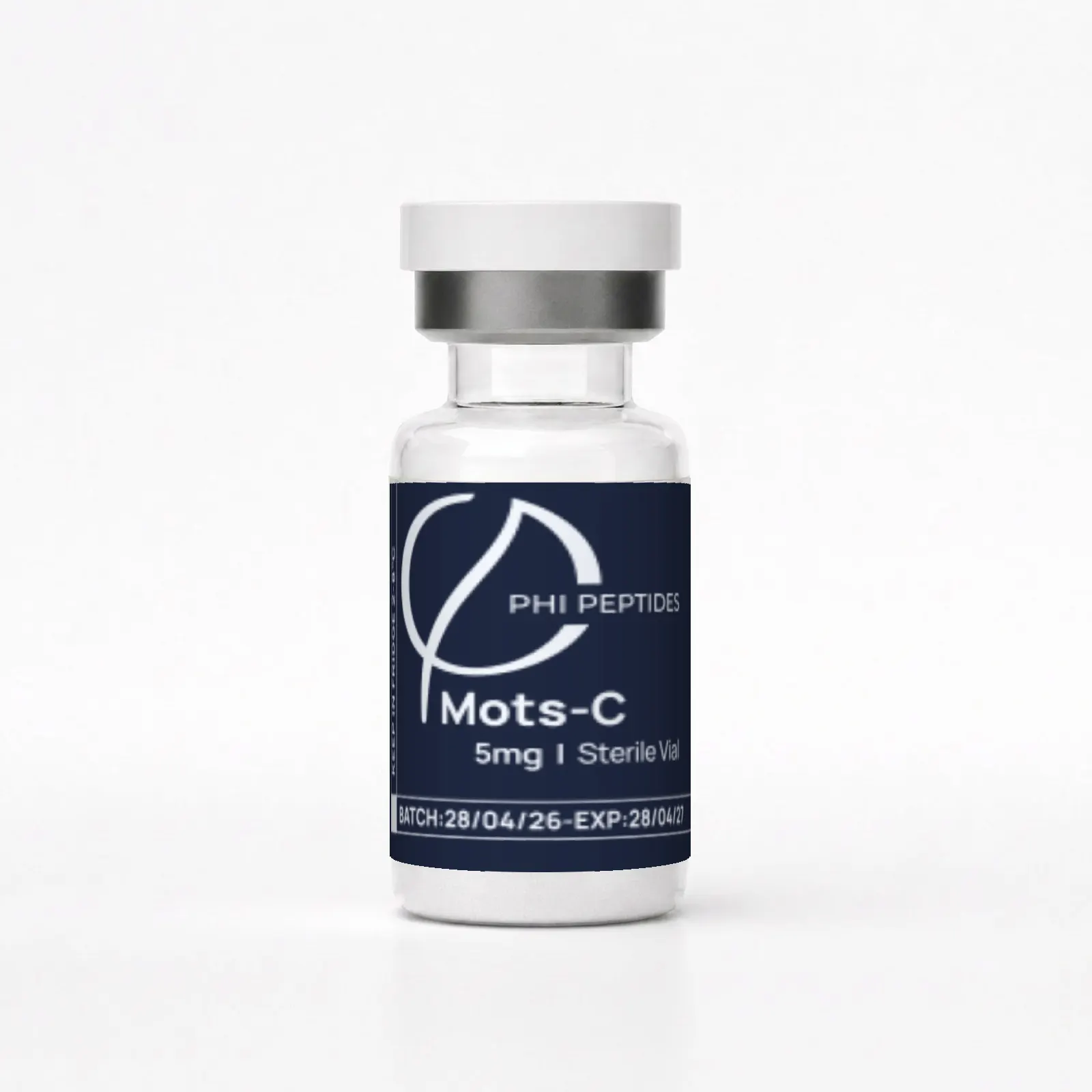
A mitochondrial-derived peptide encoded within mitochondrial DNA, acting as a metabolic regulator through the AMPK pathway.
| Standard Delivery (Signed for) | Delivered within 3-5 working days |
| Express Delivery (Standard Parcels) | Delivered within 1-2 working days |
| Extra-Large Parcels (Signed for) | Delivered within 3-5 working days |
| Furniture | Delivery usually takes place within 2 weeks. |
Allow sealed vials to equilibrate to ambient laboratory temperature before opening. This helps minimise the risk of condensation forming within the vial. Keep unopened vials stored at 2-8 C, protected from direct light and moisture. All handling, storage after opening, and laboratory procedures should be carried out according to the receiving laboratory’s established protocols and applicable requirements.
MOTS-c belongs to a class of mitochondrial-derived peptides encoded within the mitochondrial genome rather than the nucleus – a finding that reframed mitochondria as signalling organelles rather than solely energy producers. It circulates systemically and appears to act as a regulator of metabolic homeostasis, with circulating levels declining with age and rising acutely with exercise. Preclinical work in mice reports improved insulin sensitivity, resistance to diet-induced obesity and improved physical capacity in aged animals. Human work to date is largely observational and mechanistic rather than interventional: no controlled trial of exogenous MOTS-c administration in humans has been published. It is scientifically one of the more interesting compounds in the portfolio, and practitioners can present it as such while being clear that human administration data are not yet available.
Active Compound: MOTS-c (mitochondrial open reading frame of the 12S rRNA type-c)
Permitted Claim GuidelinesA mitochondrial-derived peptide studied as a regulator of metabolic homeostasis. Used under practitioner supervision. Human administration data are not yet available.
Translocates to the nucleus under metabolic stress and regulates adaptive nuclear gene expression. Activates AMP-activated protein kinase (AMPK) and interferes with the folate-methionine cycle, increasing AICAR levels. Downstream effects include enhanced glucose uptake, increased fatty acid oxidation and improved mitochondrial efficiency in skeletal muscle.
Evidence Grade: C - Strong mechanistic and rodent data; human data observational only
Clinical Evidence BaseWell-characterised molecular biology and consistent rodent metabolic data, including improvement in insulin sensitivity and physical capacity in aged mice. Human data are observational, associating circulating levels with exercise, ageing and metabolic status. No published interventional human trial of exogenous administration.
Literature & ReferencesLee C et al. Cell Metab, 2015 - the mitochondrial-derived peptide MOTS-c promotes metabolic homeostasis. | Reynolds JC et al. Nat Commun, 2021 - MOTS-c is an exercise-induced mitochondrial-encoded regulator. | Kim KH et al. Cell Metab, 2018 - mitochondrial-derived peptides in ageing and metabolic disease.
No significant toxicity reported in animal studies. Human safety data for exogenous administration are absent. Because the mechanism involves AMPK activation and glucose handling, caution is required in patients on insulin or sulfonylureas where additive glucose-lowering could occur, and glucose monitoring is sensible in that group. Not for use in pregnancy or breastfeeding. Injection-site reactions are the most commonly reported effect.
ContraindicationsPregnancy and breastfeeding; known hypersensitivity. Caution with concurrent insulin or insulin secretagogue therapy.
Storage & HandlingStore lyophilised vial at 2-8 C, protected from light.
Not authorised as a medicine in the UK, EU or US. Supplied only through appropriate professional, prescription-led channels.